
Reputation management for realtors
Reputation management for realtors is unusual because the reputation belongs to a licensed individual rather than to a location, and it moves when the agent moves. Portal agent profiles are keyed to the person and travel between brokerages; a brokerage website's testimonials do not. Reviews are typically solicited after a closing, which makes the review set small and self-selected, and the most damaging ones come from transactions that never closed for reasons the agent did not control. Because most business still starts as a referral, search results usually confirm or undermine a recommendation rather than create one.
Agent profiles are attached to a person, and they move
Almost every other local business owns its own reputation asset. An agent frequently does not.
Reviews accumulate on an agent profile hosted by a portal, and on a brokerage's website, and sometimes on a team page. When the agent changes brokerage, the portal profile usually travels with them because it is keyed to the licensed individual. The brokerage page does not. Neither does the office phone number, the team landing page, or the listings that carried the old firm's branding. A move can therefore reset a large part of an agent's visible history while leaving the rest scattered across pages the agent no longer controls.
The consequence is practical. Review assets that live on a profile keyed to the person are worth more to an agent than review assets keyed to an office, and an agent who accumulated fifty testimonials on a brokerage site over six years has built something they cannot take with them.
Zillow reviews, and where buyers and sellers actually look
- The portal agent profile. Zillow and Realtor.com profiles carry review counts and are usually the top result for an agent's name plus their city.
- Google. The map result for the agent or the team, plus whatever else ranks for the name.
- The brokerage site. Checked mainly to confirm the agent is real and currently licensed there.
- The state licensing commission. A public lookup showing licence status and any disciplinary history, and it is indexable.
- Neighbourhood groups and community pages. Where the shortlist is often actually formed, before any of the above are consulted.
- The listing history itself. Days on market, price reductions and expired listings are visible to any buyer with a portal account, and they read as a performance record whether or not that is fair.
That last item is unique to this profession. A seller comparing two agents can see something close to a track record without asking either of them, which makes the review layer a confirmation of an impression rather than the source of it.
Reviews behave differently in a transaction business
Portal agent reviews are typically tied to a completed transaction and are typically requested by the agent. That produces a pattern unlike restaurant or retail reviews: low volume, high effort per review, and a strong bias toward the closings that went well, because those are the clients an agent feels comfortable asking.
Two things follow. First, the review set is not a random sample, and buyers increasingly know that, which is why a page of uniformly glowing reviews persuades less than a mixed set with substantive detail. Second, the most damaging reviews come from transactions that never closed, where nobody asked for a review and the client wrote one anyway.
Those failed-transaction reviews deserve attention because they are the profession's characteristic case. A deal collapses on financing, an inspection turns up a structural problem, an appraisal lands under contract price, a buyer is outbid four times in a rising market. The agent controlled none of it and gets reviewed for all of it. The realistic response is not to contest the review but to answer it in a way the next reader recognises as fair: name the constraint without naming the client, describe what the process looks like when a deal fails, and stop.
Brokerage rules and testimonial use
Two rulebooks govern the marketing side, and both reach reviews and testimonials.
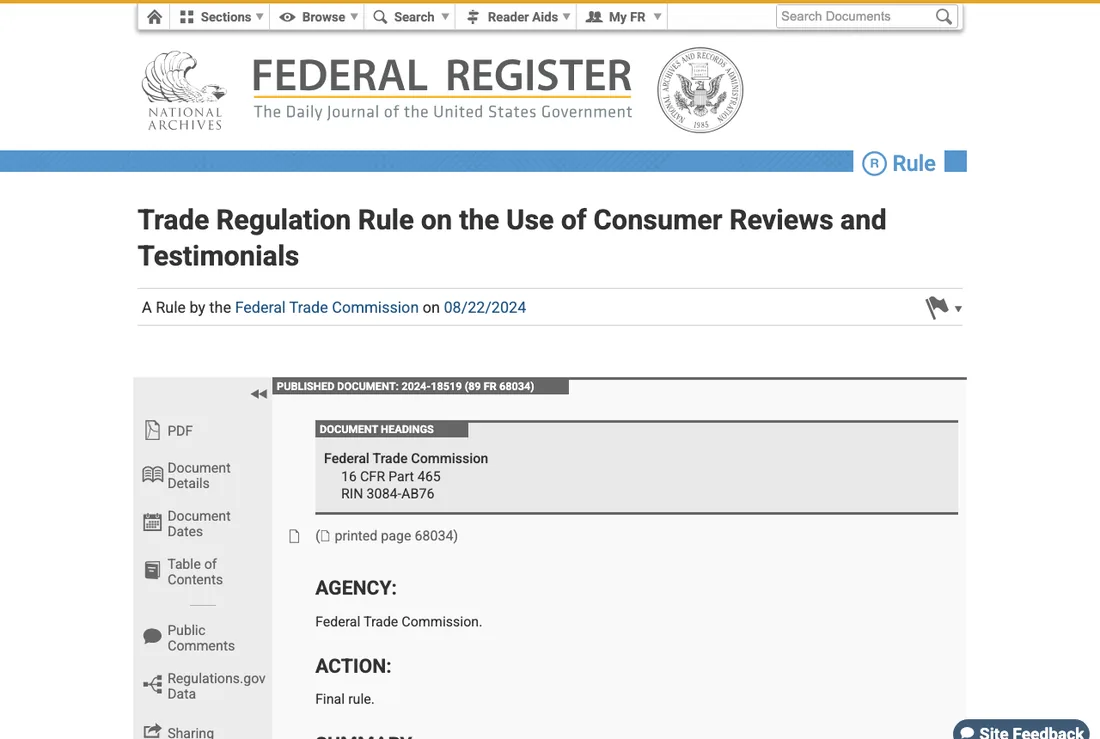
The federal rule covering fake reviews, undisclosed insider reviews, and buying positive ratings. It applies to any business that publishes testimonials, including an individual agent's own website. Screenshot taken 19 August 2026.
The FTC's own Q and A on the Consumer Reviews and Testimonials Rule is the plainest available statement of what the federal rule prohibits: fabricated reviews, reviews by insiders that do not disclose the relationship, buying positive ratings, and suppressing negative reviews on a site you control. The last one catches agents who publish only selected testimonials on their own site while presenting them as a complete set.
The professional rulebook adds a second layer. The NAR Code of Ethics requires members to present a true picture in their advertising, marketing and other representations, and it addresses claims about a member's status and about other practitioners. Most state licensing rules also require that advertising identify the brokerage, which routinely catches agents running personal social accounts and personal websites without it.
The workable position: request reviews from everyone you closed with rather than a chosen few, publish the set rather than the highlights, disclose any relationship that is not arm's length, and put the brokerage name where your state requires it. The page on review gating covers why selective solicitation is the specific practice that gets businesses into trouble.
Referral reputation is still the substrate
Search results matter for this profession mainly because they confirm or undermine a referral that already happened. Somebody recommends an agent at a dinner table, and the person they told goes and looks. What they find either supports the recommendation or quietly ends it.
That changes the priority order. A thin profile with two reviews does more damage in that moment than one negative review among thirty, because it makes the recommendation feel unverified. Volume and recency do most of the work, and an agent with a steady flow of recent, specific reviews is insulated in a way that no amount of response writing achieves.
Where to start
Claim and complete the portal profiles, because they are keyed to you rather than to your brokerage and they follow you. Get your name, licence number and market area consistent everywhere. Build a routine post-closing review request that goes to every client. Answer the failed-transaction reviews once, generally, and without naming anyone. Check that your advertising carries what your state requires. Then look at what else ranks for your name, since for an agent that set is the whole shop window, and working out which part of it is costing you listings is the first thing a reputation audit establishes.
Questions about reputation management for realtors
How do realtors build online reputation?
By requesting reviews from every client after closing rather than a selected few, keeping the portal profiles claimed and complete because those follow them between brokerages, and keeping name and licence details consistent across every listing.
Where do clients check agent reviews?
Portal agent profiles first, then Google, then the brokerage site to confirm the agent is currently there. Many also check the state licensing lookup and the agent's listing history, which is visible to anyone with a portal account.
What happens to my reviews if I change brokerage?
Reviews on a profile keyed to you as a licensed individual generally travel with you. Testimonials published on the brokerage's own website generally do not, which is a reason not to build your only review asset there.
Can an agent publish only their best testimonials?
Presenting a selected set as though it were the whole picture is the practice the federal reviews rule targets, and the professional code requires a true picture in advertising. Publish the set rather than the highlights.