Reputation management for public figures
Reputation management for public figures operates under a different legal ceiling than it does for anyone else. Under United States defamation law a public figure must prove actual malice, meaning the publisher knew the statement was false or acted with reckless disregard for whether it was, which places most unfair, one-sided or mistaken coverage beyond legal reach. Press coverage does not come down on request. The removal attempt itself carries the highest publicity risk of any client category. What is left is compositional work: corrections where a fact is wrong, accurate primary sources, and an owned record that outlasts a news cycle.
Who counts as a public figure, and why the label decides everything
The phrase has a legal meaning that determines what a person can do about false statements, and it is not a matter of fame alone.
Defamation law in the United States sorts claimants into categories. A private individual generally has to show the defendant was negligent about the truth. A public figure has to show something much harder. Courts recognise the all-purpose public figure, who has general fame or notoriety, and the limited-purpose public figure, who has voluntarily entered a particular public controversy and is treated as public only in relation to it. A business owner who campaigns publicly on a local issue can become a limited-purpose public figure for that issue while remaining private for everything else.
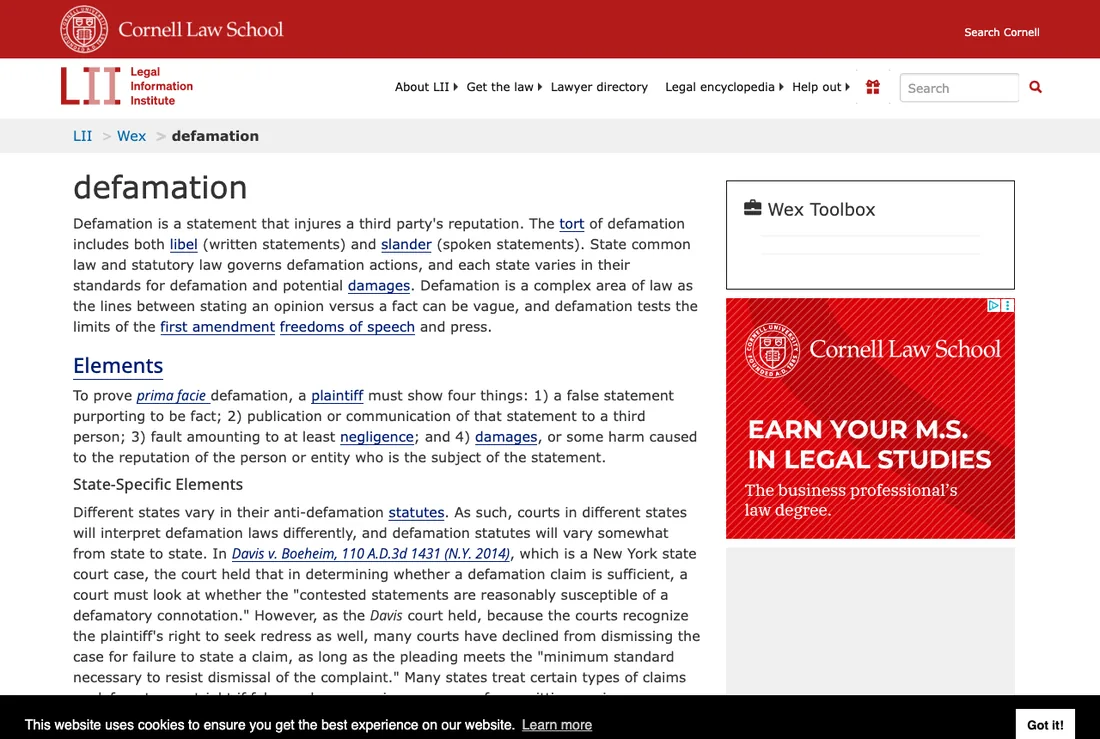
The elements of a defamation claim, from Cornell Law School's legal reference. The claimant's status as a private individual or a public figure changes the standard of fault that must be proved, which is why the classification is argued so hard at the outset of these cases. Screenshot taken 19 August 2026.
The distinction is set out in Cornell Law's definition of defamation, and it is worth reading before assuming a claim exists. Nothing on this page is legal advice.
The actual malice standard
For a public figure, proving the statement was false and damaging is not enough.
The standard comes from the actual malice standard set in New York Times Co. v. Sullivan, decided in 1964, and it exists to give reporting on public affairs room to be wrong without every error becoming a lawsuit. Its practical effect for a public figure is that a story which is unfair, one-sided, or mistaken is usually not actionable, because carelessness is not recklessness and an unflattering framing is not a false statement of fact.
That is the single most important thing for a public figure to internalise before spending money. The legal route is narrow, slow, public, and expensive, and pursuing it re-publishes the allegation in the filings.
Press coverage does not come down
Search engines do not remove news articles because the subject dislikes them, and publications do not unpublish on request as a matter of routine. The realistic options are narrower and more useful than removal.
- A correction addresses a specific factual error. Publications have a process for it, they take it seriously, and a documented error is the strongest position a subject can be in.
- An update appended to an old story is sometimes available where the situation has changed, such as charges dropped or a case dismissed. Ask for it specifically.
- A right of reply exists at some outlets, formally or informally.
- Nothing, which is frequently the correct answer for a story that was accurate.
Suppression is the remaining tool for accurate coverage that will not move, and against national press it is slow and partial rather than decisive. The page on how to remove a news article from Google sets out what is realistic.
The Streisand risk is highest for public figures
Every category of client faces some version of this. Public figures face the acute version, because the attempt to remove is itself newsworthy when the subject is known.
A legal threat sent to a journalist can become the next story, complete with the letter. A takedown demand against a small blog can be reposted by larger ones. The economics are asymmetric: the original item may have had a small audience, and the reaction to the removal attempt has the audience of whoever picks it up. This is not an argument for passivity. It is an argument for choosing routes whose failure mode is quiet, and for treating any aggressive step as a decision with a publicity cost attached.
Encyclopedia entries follow their own rules
For many public figures the encyclopedia entry outranks everything else and it is the least controllable asset they have. Its editorial norms discourage subjects from editing their own entry, its content must be supported by published sources rather than by the subject's account, and edits traced to the subject or their representatives get reverted and sometimes documented on the article's talk page.
The workable approach is the one the site itself describes: raise a specific factual inaccuracy on the talk page, disclose who you are, and cite a published source that supports the correction. Slow, occasionally frustrating, and far more effective than the alternative, which reliably makes the entry worse.
Photographs, copyright, and the limits of a takedown
Public figures often want a specific photograph gone, and the mechanism is usually misunderstood. Copyright in a photograph normally belongs to the photographer rather than the subject, so a subject cannot ordinarily issue a takedown for a picture of themselves. Where the subject or their organisation does own the image, the notice route is real: the Copyright Office on the DMCA Section 512 takedown process sets out the notice and counter-notice mechanics, and it reaches the host rather than the search engine.
Two limits. A copyright notice removes a copy, not a fact, and the story that used the photograph continues without it. And a notice filed over an image the sender does not own is a misuse of a legal process with penalties attached, which is a poor trade for a public figure.
Where effort actually pays
For a public figure the durable work is compositional rather than subtractive: primary sources under your own name, an accurate profile you control, a knowledge panel you have claimed as the subject, transcripts and recordings of what you actually said, and an archive that outlasts a news cycle. Those change what a search returns without asking anyone to remove anything, and they are the only assets that keep working when the next story arrives. Deciding which of your results is legitimately contestable and which is simply permanent is the first thing a reputation audit establishes.
Questions about reputation management for public figures
How do public figures manage reputation?
Mostly by building an accurate, indexable record they control and by requesting corrections where a specific fact is wrong. Removal plays a smaller role because most of what appears is lawful reporting, which does not come down.
What is the actual malice standard?
The standard a public figure must meet in a defamation claim: that the statement was published with knowledge of its falsity or with reckless disregard for whether it was false. It concerns the publisher's state of mind rather than ill will.
Can a public figure get an unflattering photograph removed?
Usually not on their own. Copyright in a photograph normally belongs to the photographer, so the subject has no takedown right in it. Where the subject does own the image, a copyright notice reaches the host, not the fact of the story.
Should a public figure edit their own encyclopedia entry?
No. The site's norms discourage it, edits traced to the subject are reverted, and the attempt is often documented publicly. Raising a sourced correction on the talk page with a disclosure of who you are is the route that works.