How do I remove a mugshot from the internet?
A booking photograph comes off a website when the site agrees to remove it, when a state law requires removal, or when the underlying record is sealed and the site honours that. No single request clears them all, because the same photograph is usually republished across many sites that each set their own policy. Several states now restrict what these sites can charge and require removal in defined circumstances. Expungement helps and does not automatically reach a private publisher. This page sets out the routes in the order they tend to work, and what to do about sites that will not move.
Where mugshot websites get the photograph
Booking photographs are created by a law enforcement agency at intake and are, in many jurisdictions, a public record. Mugshot sites collect them in bulk from sheriff and county sites, often automatically, and republish them alongside the name, the charge, and the date.
Two facts follow from this and they shape everything else. The site did not create the record, so it is not the origin of the information. And there is usually more than one site, because they all scrape the same county feeds.
Expungement and the source record
The most durable move is at the government end, because it addresses what the scrapers keep re-reading.
- If charges were dropped, dismissed, or never filed, ask the arresting agency and the court what their policy is on removing or restricting the record. Some jurisdictions do this on request.
- If you are eligible for expungement or sealing, that is the step that changes the official record. It is a court process with a form, a fee, and usually a waiting period, and the rules are entirely state specific.
- Ask what the agency's retention policy is for booking photographs online. Some agencies now remove them after a set period on their own.
Here is the honest limit. Sealing the court record stops the official source publishing it and stops new copies entering the pipeline. It does not, by itself, compel a private website that already holds a copy to delete it. Some state statutes and some site policies do key removal to an expungement, which is why the certified order is worth having in hand. But expungement and internet removal are two separate projects, and pages that imply the first accomplishes the second are misleading people at the worst possible moment.
State mugshot laws
The legal position has moved considerably in the last decade, and it moved in the subject's favour.
A number of states, California, Georgia, Illinois, Texas, and Utah among them, have enacted laws restricting websites from charging a fee to remove a booking photograph. Several go further and require removal on request where charges were dropped or the record was expunged, with a defined response window. The detail varies a great deal between them: who the law applies to, what triggers the obligation, what proof is required, and what the remedy is if the site ignores it.
That variance is why the statute itself is the thing to read rather than a summary of it, including this one. Nothing here is legal advice, and the applicable law is usually the one where the site operates or where you live, which are frequently not the same place.
Asking the site to remove a mugshot
- Find every copy. Search your name, your name plus the county, and your name plus the charge. Save each URL. Also search a name variant and a former address, because these sites index inconsistently.
- Locate the removal or opt-out page. Most have one, generally in the footer.
- Submit the specific URL with whatever documentation supports the request: a certificate of disposition, a dismissal, an expungement order.
- Cite the applicable statute where one exists, by section number. A site that ignores a polite request often does not ignore a citation.
- Keep the record. Date, URL, what you sent, what came back.
- Repeat for each site. There is no central request.
Pay to remove extortion, and why states stepped in
A model emerged where one site publishes the photograph and an affiliated service charges to take it down, sometimes with a fresh copy appearing elsewhere afterwards. State attorneys general have treated versions of that arrangement as extortion rather than a service, major payment processors have withdrawn from some of these sites, and the state laws described above exist largely because of it.
The practical guidance is straightforward. Check whether your state prohibits the charge before paying anything, because paying a fee the site cannot lawfully demand funds the model and does not bind anyone. Where the charge is lawful and small and the site is the only copy, it can still be a rational decision. Make it knowingly rather than under pressure.
The whack a mole problem
Removing one copy does not remove the others, and new copies can appear from the same source feed months later. Anyone who tells you a single action ends this is describing a different internet.
That is the argument for doing the source work first. A sealed record starves the feed. A removal from the largest three or four sites clears what most people actually see, because most people do not go past the first page of results. And beyond that point the effort shifts from removal to what ranks on your name.
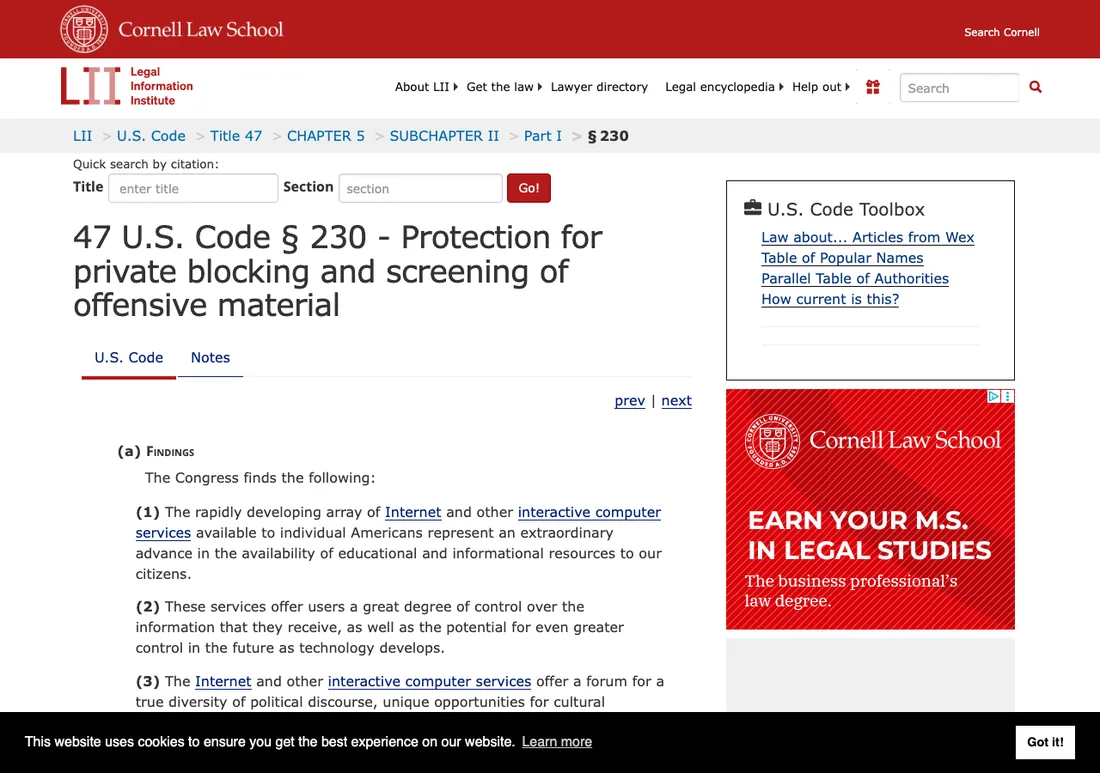
Section 230 is why a defamation claim rarely reaches a mugshot site: the site is not treated as the author of a record it republished. This is the statute the argument turns on. Screenshot taken 19 August 2026.
The legal reason a site can decline is worth understanding rather than discovering mid-argument. A site that republished an accurate public record is not the author of it, and it is generally not treated as the publisher of information provided by someone else. The text of Section 230 at Cornell's Legal Information Institute is the operative provision, and it is why the state statutes had to be written: they create an obligation that ordinary defamation law does not reach.
Delisting from search when the page stays
When a copy will not come down, the remaining question is what a name search returns. Google's free tools help less here than people expect. Google's Results About You tool is built around contact details and identity documents rather than booking photographs, so a request about a mugshot page usually falls outside its categories. Read the covered list before spending time on a filing that will be closed.
What is left is suppression: publishing and strengthening enough substantial, accurate, clearly identified material about you that the remaining copies stop occupying the first page. It is slower than removal, it changes nothing about whether the page exists, and for a persistent copy on a low quality site it is frequently the option that works.
Sorting which copies have a legal route, which have a policy route, and which are a suppression problem is the first thing a reputation audit does, and it is worth doing before the first form goes out.
What this leaves you
An ordered plan rather than a single answer. Source record first, because it stops the supply. State law second, because where it applies it is the strongest lever you have and it is free. Direct requests third, documented. Suppression for the remainder. Nobody can promise you a clean first page, and it is worth being wary of anyone who describes the outcome in those terms.
Questions about how to remove a mugshot from the internet
How do I remove a mugshot?
Address the source record first, then check whether your state restricts mugshot sites, then send documented removal requests to each site holding a copy. There is no central request, and each site sets its own policy within the law.
Will expungement remove my mugshot?
Expungement changes the official record and stops new copies entering circulation. It does not automatically compel a private website that already holds a copy, though some state statutes and site policies do treat an expungement order as a trigger for removal.
Is it legal for a site to charge me to remove a mugshot?
Several states prohibit charging a removal fee for a booking photograph, and some require removal in defined circumstances. Whether it is lawful where you are depends on the statute, so read it before paying anything. This is not legal advice.
Why does the same mugshot appear on multiple sites?
These sites scrape the same county and sheriff feeds, so one booking generates many copies. Removing one has no effect on the others, which is why the work is done copy by copy alongside addressing the source record.
Can Google remove a mugshot from search results?
Google's personal information removal tools are built around contact details and identity documents rather than booking photographs, so most requests of this kind fall outside the covered categories. Removing the page at its source is what removes the result.