What counts as a Google review policy violation?
A Google review policy violation is content in a review that breaks one of the rules Google publishes for contributions to Maps and Business Profiles. Those rules are the only basis on which a review comes down. They are published in full, they are grouped into named categories, and a report that names the right category is read differently from one that says the review is unfair. This page lists the categories Google publishes, explains what each actually covers, shows the policy page itself so you can check it, and sets out how to cite a rule when you report.
Where Google publishes its review policies
The rules that decide a review are not in the Business Profile help pages. They sit in the Maps user generated content policy, which governs every contribution a person can make to Maps and Business Profiles: reviews, ratings, photos, videos and answers. Google's prohibited and restricted content policies for reviews is the page that lists them, and it is the document a report is decided against.
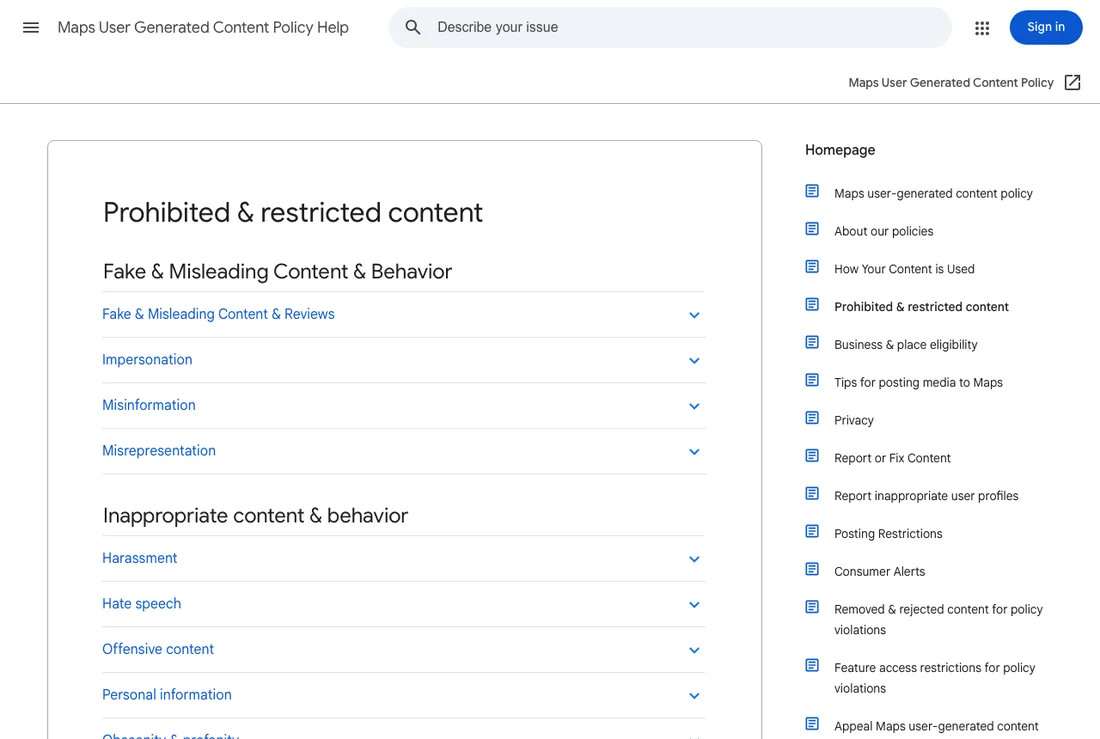
The policy itself, on Google's Maps User Generated Content Policy Help site. The named groups are visible on the page: Fake and Misleading Content and Behavior, containing Fake and Misleading Content and Reviews, Impersonation, Misinformation and Misrepresentation, then Inappropriate content and behavior, containing Harassment, Hate speech, Offensive content and Personal information. The sidebar carries the related pages on reporting content and on appealing a removal. Screenshot taken 19 August 2026.
Two things follow from reading the actual page rather than a summary of it. The categories are narrower than most people assume, and each carries its own definition that a report is judged against. There is no catch-all category for unfair.
Prohibited content: fake and misleading reviews
Google's first group covers content that misrepresents what happened or who is speaking. It contains four named things, and they are not interchangeable.
- Fake and misleading content and reviews. A review of an experience that did not happen, or content posted to deceive readers about a place. This is the category a competitor review or a bought review belongs in.
- Impersonation. Posting as another person or business, or in a way designed to look like it comes from one.
- Misinformation. Content that misleads about a place, such as claiming a business is closed, has moved, or does something it does not do.
- Misrepresentation. Content that misleads about the contributor's identity, purpose or connection to the place being reviewed.
Conflict of interest and reviews from inside the business
Google's guidance to contributors tells people not to review a business they own or work for, and not to review a current or former employer. Content posted to manipulate a rating, including a review of a competitor left to pull their average down, falls inside the fake and misleading group above rather than in a separate category of its own.
This is the category with the highest strike rate for business owners, because it is the one where evidence exists. A reviewer whose account also reviews your two nearest competitors, all in the same week, all one star, is a pattern. A five star review from an address that matches a member of staff is a pattern. Both are reportable, and both are more persuasive than an argument about accuracy.
Spam and fake engagement
Spam covers repetition and automation rather than content: the same review posted repeatedly, posts generated in bulk, ratings traded between accounts, and content posted mainly to carry a link or a phone number. Reviews used as advertising space for a different business are handled here too.
Off topic reviews, and what counts as one
An off topic review is one that is not about a customer experience at the place being reviewed. A complaint about a national brand left on one franchise location, a review that is really a political statement, and a review about a neighbouring business are all off topic. So, usually, is a review about a company's advertising rather than its service.
Off topic is a genuinely narrow category and it is over-reported. A review that describes a real visit and then makes an unrelated point is still a review of the visit.
Prohibited content: harassment, hate speech and personal details
The second published group is about the conduct in the content rather than its truth. Harassment covers targeting an individual, including a named member of staff. Hate speech covers attacks on protected characteristics. Offensive content covers obscenity and profanity. Personal information covers a phone number, a home address, a licence plate, financial details or anything else that identifies someone beyond what they chose to publish.
Personal information is the single most reliable removal argument on this list, because it is objective. Either the identifying detail is in the review or it is not.
Restricted content sits alongside all of this and works differently. It covers categories that are lawful but limited on the platform, including regulated goods such as alcohol, gambling, firearms, tobacco, healthcare and financial services. The rules there are about what may be promoted through a contribution rather than about whether the experience described was good.
Google review policies at a glance
| Policy category | What it actually covers | A report is strongest when |
|---|---|---|
| Fake and misleading content | Experiences that did not happen; content posted to deceive | You can show a pattern across accounts or listings |
| Impersonation | Posting as another person or business | The impersonated party is identifiable |
| Misinformation | False claims about the place itself | The claim is checkable, such as closure or ownership |
| Misrepresentation | Hidden identity, purpose or connection | The reviewer is a competitor, an employee, or a relative |
| Spam and fake engagement | Repetition, automation, traded ratings, embedded promotion | The same text or link appears more than once |
| Off topic | Content that is not about an experience at this place | The subject is a different business or an unrelated issue |
| Harassment and hate speech | Attacks on a person or a protected characteristic | A named individual or a slur is in the text |
| Personal information | Identifying details about a person | You can quote the detail directly |
| Restricted content | Regulated goods and services | The contribution is promoting the restricted item |
What is not on the list
Nothing in the published policy makes a review removable for being inaccurate, exaggerated, one sided, or damaging to the business. A one star rating with no text breaks no rule. An opinion that the price was too high breaks no rule. A description of a real visit that gets a detail wrong breaks no rule, because Google is not adjudicating who is right.
Pages that blur this point sell false hope. Knowing which side of the line a review sits on is what decides whether the next hour is worth spending on a report or on a reply.
How to cite a policy in a report
Google's process for reporting an inappropriate review documents the flow itself. What follows is how to make the report readable once you are in it.
- Read the category definition on the policy page, not a summary of it, and check the review actually fits.
- Pick one category. Selecting every option reads as a business that dislikes the review rather than as a rule complaint.
- Quote the words that break it. The report should point at text, not at a feeling.
- Attach the pattern where you have one, such as the other listings the account has reviewed, or the timing of a cluster.
- Record the date, the reviewer name and any case reference before you close the window. That record is what makes an appeal cheaper than the original report.
Platform policy is not the only rule in play
Google's policy governs Google. Separately, United States federal law now reaches fabricated and incentivised reviews directly, and it is aimed at businesses rather than at platforms. The FTC's announcement of the final rule banning fake reviews sets out what the rule covers.
The two systems run independently, which means a review can be a policy violation, a legal problem, both, or neither. Sorting a set of reviews into those four boxes before acting is the first thing a reputation audit does with a profile.
Questions about google review policy violations, listed
What violates Google review policy?
Fake or misleading content, impersonation, misinformation, misrepresentation, spam and fake engagement, off topic content, harassment, hate speech, offensive content, personal information, and restricted content. Those are the published categories, and a report is decided against them.
What reviews will Google remove?
Reviews that fit one of the published categories. Reviews that are simply negative, mistaken, or one sided are not covered, and no report route exists for them.
Is a review from a competitor against Google's policy?
Yes. A review from someone with an undisclosed connection to the business, including a competitor, an owner, or a current or former employee, falls inside the fake and misleading group. It is one of the more reportable categories because evidence of the connection usually exists.
Can I report a review for being untrue?
Not on its own. Google does not decide who is right about what happened. A false review becomes reportable when the falsehood also fits a category, most often because the reviewer was never a customer or has an undisclosed connection to a competitor.
Where can I read Google's review policy myself?
On the prohibited and restricted content page of Google's Maps user generated content policy help site, which is linked in the first section of this page. It is worth reading before filing, because the category definitions are narrower than the summaries suggest.