
Can you do reputation management yourself?
Yes, for a meaningful share of the work. The free routes are public and they are not secret industry knowledge: Google's own removal tools and its Results about you feature, the reporting forms every review platform and social network publishes, the opt out pages the data brokers are required to offer, and the profiles and pages you already control. Most successful removals run through those doors, including many that people pay for. What free will not do is argue a refusal, produce content at volume, or reach content that breaks no policy and no law. This page covers both halves honestly.
The free tools that actually work
Start here, because the paid conversation only makes sense once you know what the free routes cover. There are four of them that do real work, and they are not obscure.
The first is Google's own removal machinery. Google publishes policies for removing certain categories of personal information from search results, and it publishes a troubleshooter that routes your request by the type of content you are dealing with. It costs nothing, it does not need a lawyer, and for personal contact details it is the single highest yield thing an individual can do.
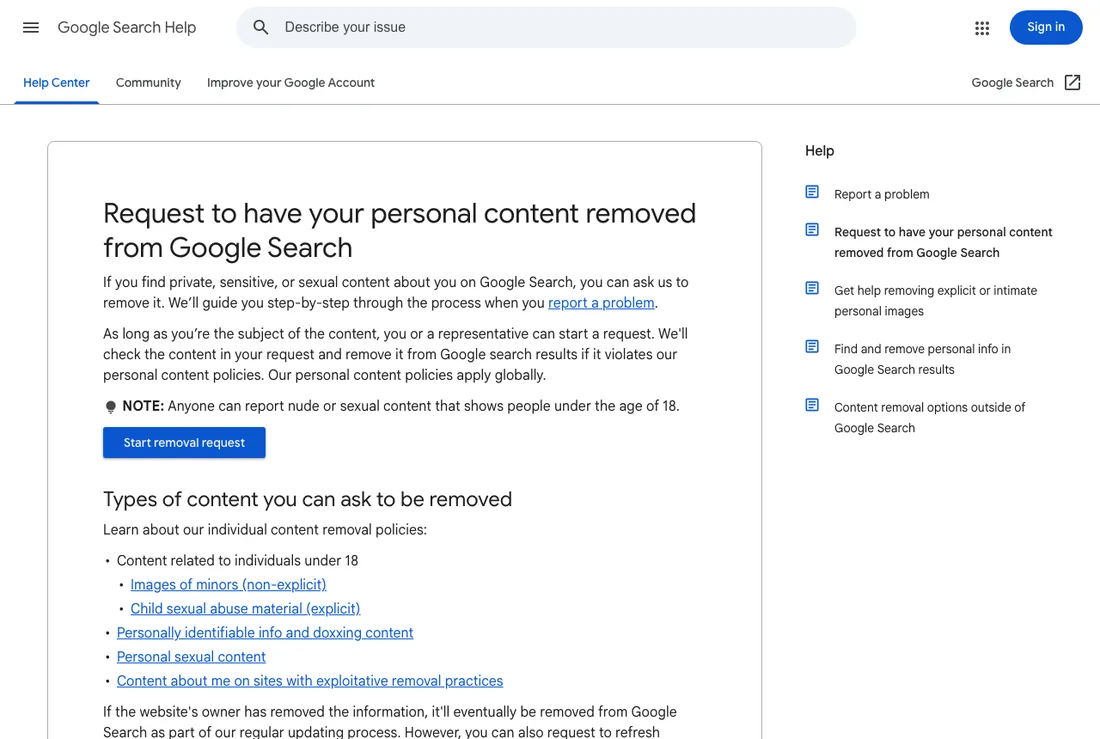
Google's own removal troubleshooter. It asks what kind of content you have and sends you to the right form. Anyone can use it, free, without a provider in between. Screenshot taken 19 August 2026.
Google Results about you, and what it covers
Google's Results about you tool is the consumer facing front end to the same policy. You give it your name, phone number, home address and email, and it watches search results for pages carrying those details. When it finds one, you can request removal from inside the tool and track the request.
Two honest limits. It is scoped to personal contact information, so it will not touch an unflattering article, a review, a court record, or an opinion about you. And it removes results from Google, not the page itself, so the data broker still holds the record and other search engines may still surface it. Within that scope it works, it is free, and there is no version of this a provider can do that you cannot.
Platform flagging, the highest yield free move
Every major platform publishes rules about what it will remove, and enforces them through a free reporting form. This is where most successful removals actually happen, including most of the ones people pay for.
The reason it works is that the request is a policy argument, not a legal one. A review that names a person who is not a customer, contains profanity, promotes a competitor, or was posted by someone with no transaction is a policy violation on most review platforms. Point at the exact clause it breaks, quote the language, and submit. A review that is simply negative and true breaks no policy, and no amount of reporting will change that.
Two practical notes. Report once and properly rather than repeatedly and vaguely, because repeated identical reports are treated as noise. And if the content is spoken rather than written, understand what you are dealing with: that is slander rather than libel under most state law, and there is no page to file a takedown against at all.
Data broker opt out, and why it has to be repeated
People search sites are the reason your address and relatives appear when someone searches your name. Almost all of them publish an opt out page, because privacy law in several states requires a deletion path. Working through them is free. It is also tedious, and it does not stay done, because brokers re acquire records from public sources and repopulate.
That repetition is the honest reason opt out services exist as a paid category. They are not doing anything secret. They are doing something repetitive on a schedule. If you have the patience to redo it a few times a year, you do not need to buy it.
Building the results you do control
Suppression sounds like a dark art and mostly is not. The pages that rank for your name rank because search engines judge them relevant and trustworthy for that query. You already own or can create several properties that qualify: your own site or a personal page on it, a complete LinkedIn profile, a professional association listing, an author or speaker page, a properly filled out business profile.
None of this requires special knowledge. Google's own SEO starter guide is the source document, it is written for beginners, and it says the unglamorous thing out loud: make pages that are genuinely about the subject, keep them accessible, and link them together sensibly. Doing that consistently for your own name is a real DIY reputation strategy. It is also slow, which is the point of the next section.
DIY reputation management, in a sensible order
- Search yourself properly first. Logged out, in a private window, on both a desktop and a phone. Write down every result on the first two pages and what kind of content each one is. You cannot triage what you have not inventoried.
- Run each result against the host platform's published policy. Anything that violates a rule goes to the free reporting form with the clause quoted.
- Run the personal data items through Google's removal tools. Contact details, doxxing content, and certain financial and identity records have their own forms.
- Work the data broker opt outs. Start with the ones that actually rank for your name rather than the full list of hundreds.
- Build and complete the properties you control. Then leave them alone long enough for search engines to notice.
- Re run the search in a month and compare against your inventory. This is your measurement, and it is the same measurement any provider would use.
The DIY ceiling: where free stops working
Free stops working at four fairly specific places, and a provider who will not tell you this is not worth hiring.
| Situation | Why free stalls |
|---|---|
| Content that violates no policy and no law | There is nothing to report. The only route left is suppression, which is slow and needs material. |
| A high authority site ranking for your name | A new LinkedIn profile does not outrank a national news domain. Suppression here needs more and better material than one person usually produces. |
| A site that publishes no removal path and answers nothing | The free route ends at an unanswered email. What remains is legal or nothing. |
| An anonymous author making false factual claims | Identifying them means litigation and a subpoena, which is a real lawsuit with real cost, and it makes the dispute public. |
There is a fifth ceiling that is about you rather than the content: sustained attention. DIY work is not hard, it is repetitive, and it fails most often because the person doing it stops after three weeks. If you know you will not keep going, that is a legitimate reason to pay someone, and a more honest one than most of the reasons providers offer.
What paying for it actually buys
Not secret access. Providers use the same public forms and the same public policies you do. What a competent one adds is pattern knowledge about which platform responds to what, the willingness to appeal a refusal three times, and the capacity to produce content at a volume one person cannot sustain. Whether that is worth the price depends entirely on which side of the ceiling your situation sits on, and the honest ranges are on the page about what reputation management costs.
If you work through the order of operations above and still cannot tell which side of that ceiling you are on, a reputation audit answers exactly that question and costs nothing to request.
Questions about diy reputation management: how far you can get free
Can I do reputation management myself?
A large part of it, yes. Platform reporting, Google's removal tools, data broker opt outs and building your own profiles are all free and public. What you cannot do alone is produce content at volume or work an appeal process repeatedly over months, which is where most people stop.
How do I remove my personal information for free?
Use Google's removal troubleshooter and its Results about you tool for search results carrying your contact details, then work the opt out pages on the people search sites that actually rank for your name. Both are free and neither needs a provider.
Does DIY reputation management actually change search results?
For personal data and policy violating content, yes, often within weeks. For lawful unflattering content, changing what ranks takes sustained work over months and depends on how strong the sites currently ranking are.
Do data broker opt outs stay done?
No. Brokers rebuild records from public sources, so listings reappear. Redoing the opt outs a few times a year is the free version of what opt out subscriptions sell.
When is DIY the wrong choice?
When the content breaks no policy and sits on a high authority domain, when the host answers nothing, when the author is anonymous and making false factual claims, or when you know you will not keep at it for several months.