How do you get more Google reviews?
You get more Google reviews by asking every customer, at the moment the work is finished, with a direct link that takes one tap. That is the whole legitimate method. It works because most satisfied customers will leave a review when they are asked and almost none will do it unprompted, so the variable that moves volume is the consistency of the ask rather than its cleverness. What puts a Business Profile at risk is every attempt to shortcut it: paying for reviews, offering anything in exchange, filtering who gets asked, or soliciting people who were never customers. This page covers the compliant method and names the rule each shortcut breaks.
The review link and where to put it
Every verified Business Profile has a short link that opens the review form directly, with the star selector already on screen. Google generates it inside the profile. Sending someone to search for you instead adds three steps, and most people drop out inside those three steps.
Put the link where the customer already is at the moment the work finishes:
- On the invoice or the receipt, printed and emailed.
- In the message that confirms the job is complete or the order has shipped.
- On a card handed over at the end of the visit, with a QR code that opens the same link.
- In the email signature of the person the customer actually dealt with.
One place it does not belong is a page on your own site that asks people how it went before it shows them the link. That is review gating, and it is covered below.
Timing the ask
Ask at the point of completed value: when the work is finished, when the problem is solved, when the thing has been used at least once. Ask a customer before they have experienced the outcome and you are asking about the sales process. Ask three weeks later and the detail that made the review worth reading is gone.
The other half of timing is consistency. A business that asks every customer, every time, will build review volume from ordinary operations. A business that asks in bursts when the rating dips builds a spiky arrival pattern, which is one of the patterns automated systems read as inauthentic.
Writing the review request
Four things belong in the request and nothing else: who is asking, what it is about, the link, and how long it takes. Anything longer reads as marketing and gets skipped.
Do not tell people what to say. A set of reviews that all use your suggested phrases reads exactly like a set of reviews that all came from the same template, to a reader and to a filter. Do not ask for five stars either. Asking for the rating rather than the review is the small step that turns a legitimate request into a manipulated sample.
Review gating: asking everyone, not only the happy ones
Gating is a violation for a straightforward reason: it manufactures a rating that does not describe the customer base. Google's contribution policies prohibit soliciting reviews selectively in this way, and the same behaviour sits inside the conduct the Federal Trade Commission's review rule addresses when the effect is to suppress negative reviews. Google's prohibited and restricted content policies for reviews is the platform half of that.
The compliant version of the same instinct is to ask everyone, and to route service recovery separately. Send the review request to every customer. Send a private follow-up asking how it went to every customer as well, and act on the answers. What you may not do is use the second one to decide who gets the first.
What is not allowed, and the rule each shortcut breaks
| Shortcut | Why it is a violation |
|---|---|
| Offering a discount, a draw entry, or a free item for a review | Platform policy prohibits incentivised reviews, and the federal rule reaches undisclosed incentives that produce distorted reviews |
| Paying a service to post reviews | The reviews describe experiences that never happened, which is fake content under policy and a fabricated review under the rule |
| Staff, family or friends posting reviews | Undisclosed connection to the business; a misrepresentation under policy |
| Showing the review link only to satisfied customers | Review gating; a selective solicitation that misstates the customer base |
| Sending review requests to a bought or scraped list | The recipients are not customers, so the reviews cannot describe a real experience |
| Offering anything in exchange for changing or removing a bad review | Buying a change in the review record, which is the same conduct as buying the review |
| Reviewing a competitor to lower their average | Prohibited content posted to manipulate a rating |
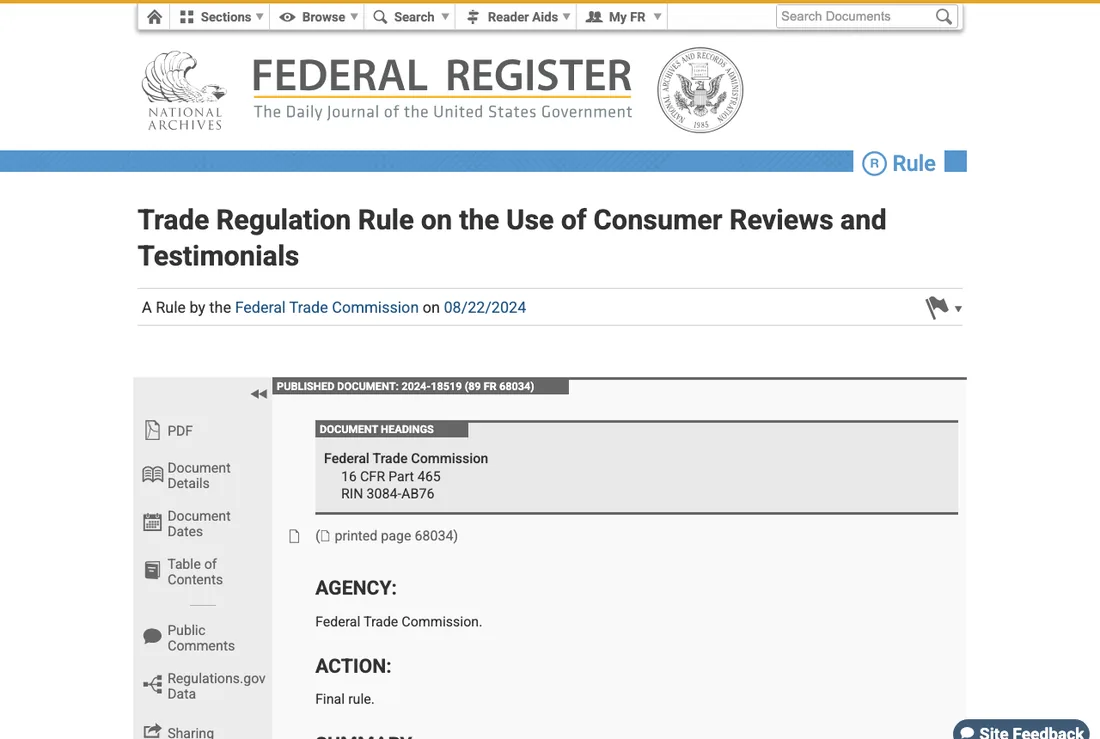
The federal layer underneath every platform policy on this page: the Trade Regulation Rule on the Use of Consumer Reviews and Testimonials, a final rule by the Federal Trade Commission published 22 August 2024 at 16 CFR Part 465. Screenshot taken 19 August 2026.
The rule is written at businesses rather than at platforms, which is what makes it different from a policy violation: the exposure lands on the company that benefited. The FTC's own Q and A on the Consumer Reviews and Testimonials Rule is the plain language version, and it is short enough to read before your next campaign goes out.
What volume actually moves
Review count and review score are among the inputs Google names in Google's guidance on local ranking factors, alongside relevance, distance and prominence. So the effect of a steady stream of legitimate reviews is not only the visible average. It is also the profile's standing in local results.
The second effect is on how a single bad review reads. Inside a handful of reviews, a one star account is the profile. Inside several hundred, it is one person's afternoon. Nothing dilutes a harsh review as reliably as ordinary customers describing ordinary service, and no removal process reaches the review that dilution handles for free.
When the review request stops working
Review generation fails for three reasons, and only one of them is about the ask. The first is that nobody owns it, so it happens in bursts. The second is that the link is buried, so the customer would have to go looking. The third is that the request goes out days after the work, from an address the customer does not recognise.
If those are fixed and the reviews still are not arriving, the honest possibility is that the experience is not producing them. Review volume is an operational metric before it is a marketing one, and reading the last twenty reviews as a group tells you more about that than any tool will. Working out which of the three is actually in play is part of what a reputation audit looks at.
Questions about how to get more google reviews, legitimately
How do I get more Google reviews?
Ask every customer when the work is finished, using your profile's direct review link, and ask consistently rather than in bursts. Put the link on the receipt, in the completion message, and on a card with a QR code.
Is it against policy to ask for reviews?
No. Asking customers for reviews is allowed. What is not allowed is asking selectively based on how happy someone seems, offering anything in exchange, or asking people who were not customers.
Can I offer a discount for a review?
No. Incentivised reviews are prohibited by platform policy, and undisclosed incentives that distort the review record are also the subject of the FTC's review rule, which is aimed at the business rather than the platform.
Is it acceptable to survey customers before sending the review link?
Only if the survey does not decide who receives the link. Surveying everyone and sending the link to everyone is fine. Using the survey answer to filter who sees the link is review gating.
How many reviews should a business aim for?
There is no published threshold, and any specific number quoted to you is somebody's guess. The measures that matter are whether reviews arrive steadily, whether they are recent, and whether the volume is large enough that one bad review is not the whole picture.