
Does the US have a right to be forgotten?
No. The United States has no general right to be forgotten. There is no federal law that lets an American require a search engine to delist accurate, lawfully published information about them because it is old, unflattering, or no longer relevant. The First Amendment protects the publication of truthful information on matters of public concern, and that protection is what a general right of this kind would have to overcome. What Americans do have is narrower and more specific: state privacy laws with a right to delete certain data, a data broker deletion regime in California, and removal policies search engines apply voluntarily.
Why there is no right to be forgotten in the US
Two features of American law block it. The first is constitutional. The second is Section 230, which means the sites holding the content are not treated as its publishers and so cannot easily be ordered to remove it. That rule is explained on what is Section 230.
Proposals for an American version appear regularly in state legislatures and in academic writing. None has produced a general right, and the reason is consistent every time: a law compelling the removal of truthful, lawfully obtained information runs directly into the First Amendment.
The First Amendment problem
A line of Supreme Court decisions has held that publishing truthful information about a matter of public significance, lawfully obtained, can only rarely be punished. The cases involved a rape victim's name taken from a court record, a juvenile defendant's name obtained from witnesses, and a name published from a police report. In each, liability for accurate publication was struck down.
That is not a technicality. It means that in the United States, the fact that something is true and was lawfully published is close to the end of the discussion, whatever the consequences for the person it describes. The First Amendment Encyclopedia on the right to be forgotten traces the American debate and the specific constitutional obstacles a domestic version would face.
State privacy laws, and what they actually reach
What has arrived instead is a patchwork of state consumer privacy laws, beginning with California and now covering a substantial and growing group of states. Every one of them gives residents some version of a right to delete personal data.
They are useful and they are not a right to be forgotten. Three limits explain why.
They bind businesses that collect and process personal data, not publishers exercising editorial judgment. They generally apply to data a business collected about the consumer, not to a third party's account of events. And they exclude publicly available information from the definition of personal information altogether.
The CCPA and its publicly available carve out
California's law is the clearest illustration. The California Consumer Privacy Act gives residents a right to request deletion of personal information a business has collected from them, subject to a list of exceptions covering things like completing a transaction, security, and legal obligations.
That carve out is the whole answer for most people arriving at this page. A newspaper article about you is publicly available. A court record is a government record. Neither is reachable by a deletion request, no matter how old it is or how much it has cost you.
The Delete Act and data brokers
California went further for one specific industry. The Delete Act requires data brokers to register with the state and to honour deletion requests submitted through a single platform operated by the California Privacy Protection Agency, so that one verified request reaches every registered broker rather than requiring a separate submission to each.
This is the most substantial thing an American can do in a single action, and it matters because data brokers are what feed people search sites. It reaches broker held profiles: addresses, relatives, phone numbers, aggregated public records repackaged for sale. It does not reach the original source of any of it. More on that route is on data broker opt out.
What Americans can actually request
| Route | What it reaches | What it does not |
|---|---|---|
| State right to delete | Personal data a covered business holds about you | Publicly available information, news, court records |
| California data broker deletion | Profiles held by registered data brokers | The public records the profiles were built from |
| Search engine personal information removal | Results exposing contact details or identifying numbers | The page itself, and most news, government and education sources |
| Legal removal request | Content a specific law or a court order reaches | Lawful, accurate content you simply dislike |
| Platform policy complaint | Content that violates the platform's published rules | Truthful negative content that breaks no rule |
Google's own tools sit in the third and fourth rows. Google's Results About You tool lets you ask for results showing your phone number, home address, email address or identifying numbers to be removed from Search, and Google states plainly that this does not remove the information from the internet: the source page keeps it. It also declines removals from sites it considers broadly useful, including government, educational and news sites.
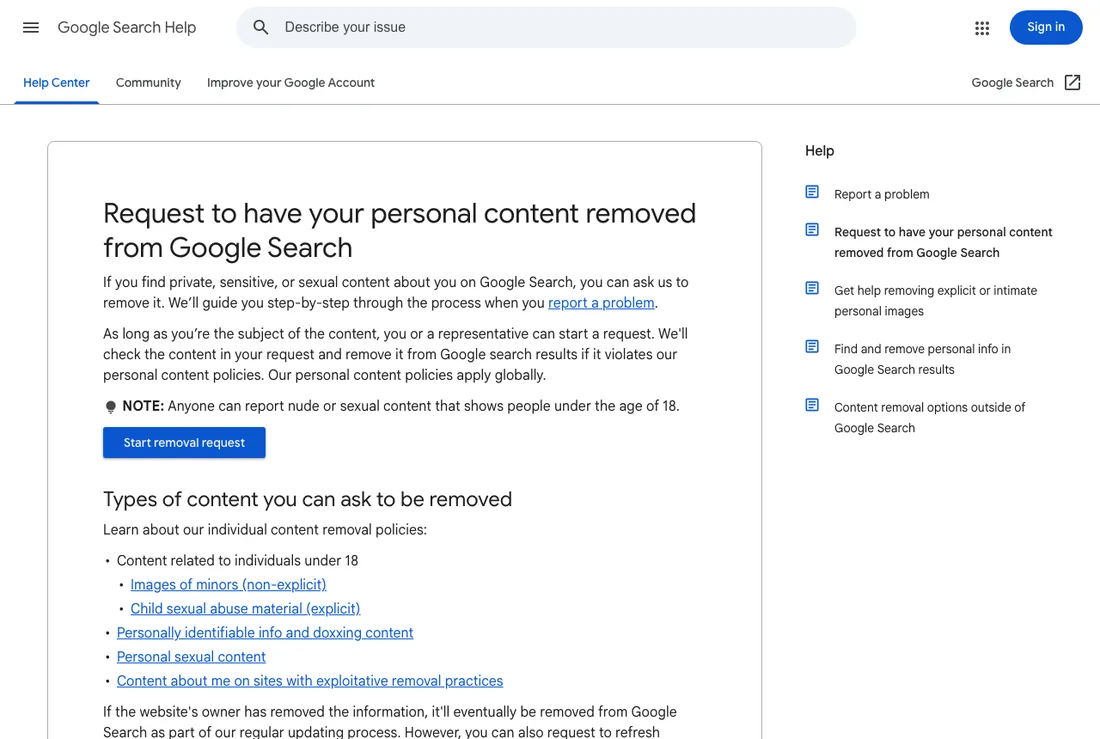
Google's removal troubleshooter, the entry point for its policy based removal routes. It is a company process, not a legal right, and Google decides the outcome. Screenshot taken 19 August 2026.
What none of this does
Say this part out loud, because it is where most expectations break. An expungement clears a criminal record; it does not remove the news article about the arrest, and the publisher is under no obligation to take it down. Deleting your own account does not delete other people's posts about you. Delisting is not deletion anywhere, including in Europe, which is covered on what is the right to be forgotten.
Where nothing legal applies and the content is accurate and lawful, the honest remaining option is to change what ranks rather than what exists, which is covered on what is search suppression.
Nothing here is legal advice, and state privacy law changes every year. The statutes and the company policies are linked so you can check the current position at the source. Working out which of the five rows above your situation falls into is most of the work, and it is the first thing a reputation audit establishes.
Questions about does the us have a right to be forgotten?
Does the US have right to be forgotten?
No. There is no general American right to be forgotten. The First Amendment protects the publication of truthful information on matters of public concern, and no federal law lets a person require a search engine to delist accurate, lawfully published material about them.
What state laws apply?
A growing group of states have comprehensive consumer privacy laws giving residents a right to delete personal data a business holds. They bind businesses that process data rather than publishers, and they exclude publicly available information, so they do not reach news articles or court records.
Can I get a news article about me removed in the US?
Not through a privacy request. A published article is publicly available information and is outside the state deletion rights. Removal depends on the publisher agreeing, on a court order in a narrow case, or on the content violating a specific law.
Does an expungement remove articles about the arrest?
No. Expungement addresses the criminal record held by the court and the state. It places no obligation on a newspaper or a website to remove its own coverage, and search engines do not delist the coverage automatically.