
How does reputation management work?
Reputation management works in five stages. An audit records what a search currently returns. Each item is classified as removable, correctable, or permanent. Removal requests are filed under whichever platform policy or law actually reaches the content. Whatever cannot be removed is suppressed by publishing and strengthening accurate material until it falls out of view. Then the position is measured again against the starting record. Removal runs on rules somebody else wrote, so it succeeds or fails quickly. Suppression runs on search ranking, so it is measured in months. Most engagements are a mix, and the audit decides the mix.
The audit: what a search actually returns today
Everything starts with a written record of the current position. Not an impression, a record: the first two or three pages of results for your name and its close variants, each item captured with its address, its owner, its date, and whether it reads as positive, neutral, or negative. The same exercise on the review platforms you appear on, plus the AI assistants people now ask instead of searching.
The audit does two jobs. It fixes a baseline, so that any later claim of improvement can be checked rather than believed. And it turns a vague feeling into a finite list, which is usually shorter than people expect. A first page holds about ten results. That is the actual battlefield.
Classifying each item: removable, correctable, or permanent
Every item on the list falls into one of three buckets, and the classification decides the whole plan.
- Removable. The content breaks a platform's published policy or is reached by a specific law. A fake review, a doxxing post, an impersonating account, infringing material, certain categories of personal data.
- Correctable. The content is legitimate but wrong. A misreported fact, an outdated business detail, an old address in a directory, a court record that has since changed.
- Permanent. The content is lawful, policy-compliant, and either true or protected opinion. A truthful negative review. A news article about a real event. A public court filing. Nothing removes these, and any provider who says otherwise is describing a service they cannot perform.
That third bucket is the honest part of this work and the part sales pages leave out. Sorting into it early is what stops money being spent on requests that were never going to be granted.
Removal: filing under a rule somebody else wrote
Removal is not persuasion. It is matching a piece of content against a written rule and showing the match. Each platform publishes its rules and its complaint route, and the route is free.
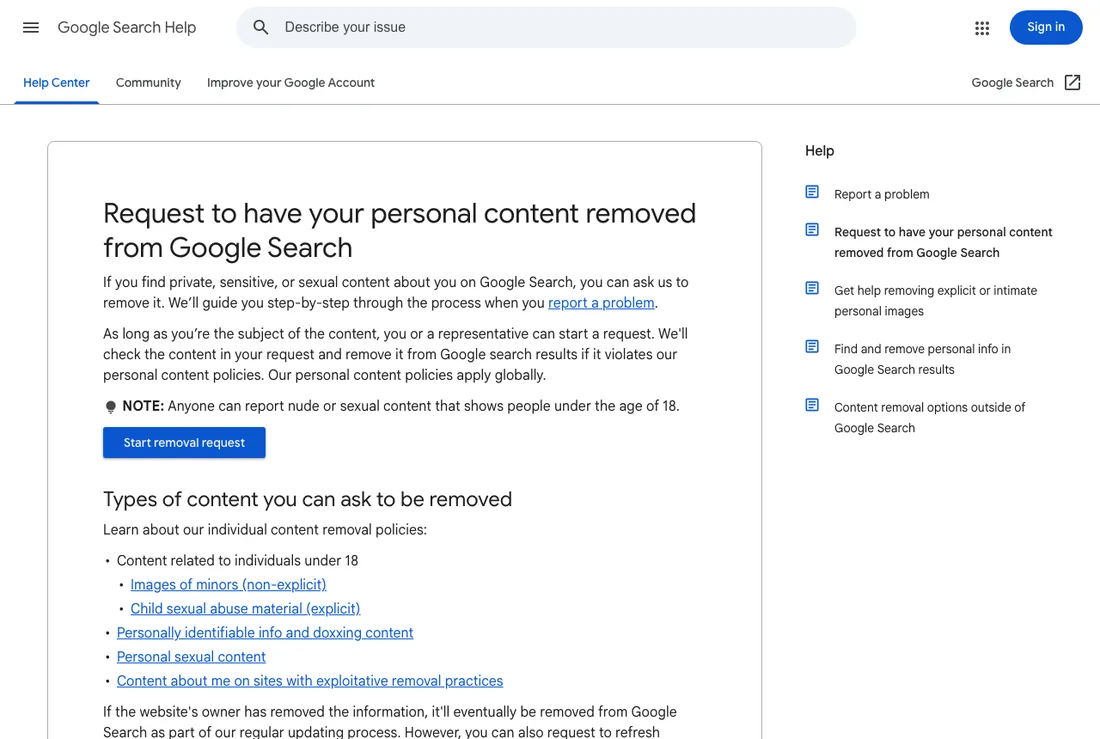
Google's removal troubleshooter sorts a request by content type rather than by how upsetting the content is. That distinction is the whole game: the tool answers policy questions, not fairness questions. Screenshot taken 19 August 2026.
Where platform policy does not reach, a specific law sometimes does. Copyright notices reach hosts directly. Privacy statutes reach data brokers. In the European Union, Article 17 of the GDPR, the right to erasure gives individuals a right to have certain personal data deleted, subject to exceptions that include journalism and freedom of expression. The United States has no general equivalent, which is why American removal work leans so heavily on platform policy instead.
Removals tend to resolve quickly or not at all. A well-founded complaint is usually decided within days or a few weeks. A rejected one is rarely rescued by filing it again in different words. It is rescued by finding a different rule that actually fits the content.
Suppression: what happens when nothing comes down
When an item sits in the permanent bucket, the only remaining lever is position. Suppression means publishing and strengthening accurate material until the unwanted result is no longer in the range where people look.
This is ordinary search work pointed at a name. The pages built have to be genuinely findable, which means the fundamentals in Google's own SEO starter guide apply exactly as they would to a product page: a clear title, content worth reading, links that make sense, and a page a crawler can reach.
What gets built is usually some combination of an owned site with a real about page, claimed and completed profiles on the platforms that already rank for names, professional directory entries, published writing or interviews, and structured data that helps a search engine tell one entity from another. The aim is not a wall of thin pages. Thin pages do not hold position, and a first page made of obvious filler tells a reader more about you than the item you were trying to move.
Measurement: proving the position moved
Measurement is the same audit, repeated on a schedule and compared to the baseline. The honest metrics are the position of each item, the composition of the first page as a whole, review average and volume by platform, and increasingly what an AI assistant says when asked about you. The dishonest metric is a single score with no published method behind it.
Anything a provider then publishes about those results carries advertising obligations of its own. The FTC's advertising and marketing guidance for businesses requires objective claims to be truthful and substantiated before they are made, and that applies to a reputation firm's case studies exactly as it applies to a client's.
How long reputation management takes
The honest answer is that it depends which bucket your items are in, and the audit tells you that before you spend anything.
Policy-based removals are decided in days or weeks. Corrections depend on whoever has to make them and can take anything from an afternoon to a month. Suppression is the slow one, because a page has to be published, indexed, linked, and then climb, and search engines move at their own pace. Engagements that are mostly suppression are measured in months, and anyone quoting a fixed date for a ranking change is quoting something they do not control.
The sequence, end to end
- Capture the baseline. Signed out, first three pages, every item recorded with a date.
- Classify every item as removable, correctable, or permanent.
- File removals and corrections against the specific rule that fits each one.
- Publish and strengthen accurate material for whatever is left.
- Re-measure on a fixed schedule, against the baseline rather than against a feeling.
- Keep monitoring, so the next item is caught while a calm response is still possible.
Steps one and two are the entire diagnosis, and they are exactly what a reputation audit produces before any of the work is quoted.
Questions about how reputation management actually works
How does reputation management work?
It audits what a search returns, sorts each item into removable, correctable, or permanent, files requests under the rule that fits each one, and publishes accurate material to outrank whatever is left. Then it measures the change against the starting record.
How long does reputation management take?
Policy-based removals are usually decided in days or weeks. Corrections vary with whoever has to make them. Suppression is measured in months, because a page has to be published, indexed, linked, and then climb.
What cannot be removed?
A truthful negative review, a factual news article, and a public court filing are all lawful and policy-compliant, so no complaint route reaches them. For those, position is the only available lever.
Do I have to pay for the audit stage?
No. The audit is a signed-out search, recorded carefully, and anyone can do it. The reason to have it done for you is classification, which is where knowing the platform rules changes the answer.
Does deleting my own accounts fix it?
Rarely, and sometimes it makes things worse. Deleting a profile removes a page you controlled and leaves the ones you did not, which frees up first-page positions for other people's content.