What does corporate reputation management involve?
Corporate reputation management is the coordinated work of keeping what an organisation's stakeholders conclude about it accurate and current, across every group that holds a claim on it. At enterprise scale it stops being one activity. A company does not have a reputation. It has a customer reputation, an employer reputation, an investor reputation, a regulatory standing and a partner standing, each formed from different evidence and each capable of moving independently. The work is coordination between the functions that own those relationships, plus a shared view of what is publicly findable.
What corporate reputation management covers
Three things, none of which belong to a single department. First, knowing what each stakeholder group currently concludes and on what evidence. Second, making sure the organisation's own published record is accurate, complete and reachable, since that record is what most people encounter before they encounter anybody. Third, having the machinery to respond when a conclusion shifts, which is where it meets issues and crisis work.
What it is not is a communications campaign attached to an unchanged organisation. Corporate reputation is unusually well supplied with evidence: regulatory filings, court records, employee-review sites, product reviews, trade coverage and search results all persist and are cross-checkable. That is why the sequence has to be fix, then say, and why the reverse order tends to produce a second problem.
Enterprise reputation is several reputations at once
| Stakeholder group | What they judge on | Where it shows publicly | Who usually owns the relationship |
|---|---|---|---|
| Customers | Product quality, service recovery, pricing honesty | Reviews, ratings, support forums, comparison sites | Marketing and service |
| Employees and candidates | Management, pay, safety, whether stated values match practice | Employer-review sites, professional networks, alumni | Human resources |
| Investors and lenders | Governance, disclosure quality, consistency of guidance | Filings, analyst notes, financial press | Investor relations |
| Regulators | Compliance history, candour, speed of remediation | Enforcement records, consent orders, inspection reports | Legal and compliance |
| Partners and suppliers | Payment behaviour, contract conduct, predictability | Trade press, industry networks, procurement references | Procurement and commercial |
| Local communities | Environmental and employment impact, presence | Local media, planning records, community forums | Public affairs |
The independence of these is the operationally important part. An organisation can have an excellent customer reputation and a poor employer reputation at the same time, and the second one will eventually reach the first, because candidates and customers read the same internet.
Stakeholder trust and who judges what
Trust here is specific rather than general. Each group trusts an organisation to do a particular thing: to ship what it described, to pay on the agreed day, to disclose promptly, to remediate a finding rather than close it. Failures are group-specific too, which is why a broad reassurance campaign rarely repairs anything. The group that lost confidence lost it about something in particular.
The research on how audiences assign responsibility after a failure is directly relevant, because how much reputational damage an event causes depends heavily on whether people read it as an accident or as preventable. The Institute for Public Relations on crisis management and communications summarises that body of work, and the operational consequence is that what an organisation was told beforehand often matters more to the outcome than the event itself.
Employer brand as a reputation surface
Employer reputation used to be private. It is now the most consistently published surface a large organisation has, because employee-review sites, professional networks and alumni commentary are all indexed and all searchable by name.
Two practical consequences follow. Candidates read it before an interview, so recruiting cost is one of the first places employer reputation shows up as money. And it is a leading indicator for everything else: conduct problems, safety issues and management failures appear in employee accounts well before they appear anywhere a customer would look.
Investor perception and the disclosure constraint
Investor-facing reputation is the one governed by rules rather than by preference. What can be said, to whom, and when is constrained by disclosure regulation, and the communications instinct to reassure early collides with it directly. Anything material said to one group has to be handled as a disclosure question rather than as a messaging question, and the sequencing has to be worked out with counsel before an incident rather than during one.
This is also where a professional standard earns its place. The PRSA Code of Ethics sets provisions on disclosure of information and on safeguarding confidences, and the tension between those two is exactly the daily working condition of an investor relations function.
Measurement, and what a score can tell you
Corporate reputation measurement is a real commercial field, and it is worth knowing what the instruments do before buying one.
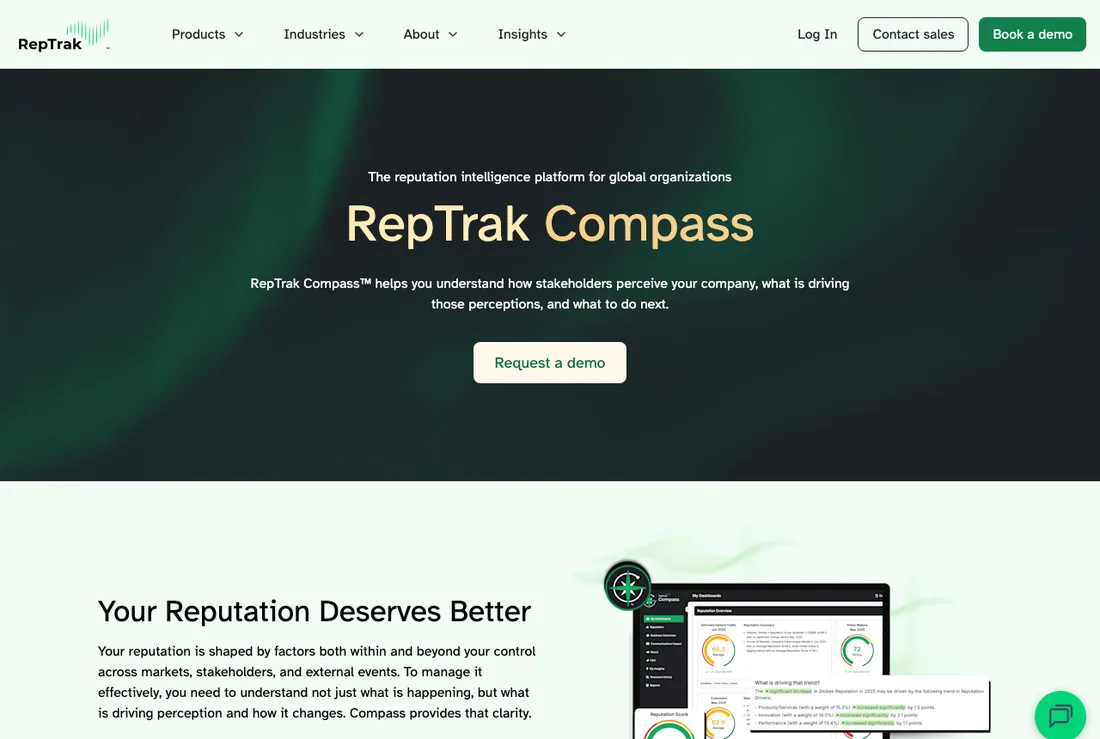
A commercial reputation measurement platform, positioned around understanding how stakeholders perceive a company and what is driving those perceptions. Products in this category survey defined populations and score perception across dimensions. What they measure is stated opinion at a point in time, which is useful and is not the same thing as behaviour. Screenshot taken 19 August 2026.
Survey-based scores are best read as one input among several. They are slow, they sample a population that may not match the groups that actually decide, and a single composite number hides the group-level movement that matters. Read alongside them: what a search for the organisation returns, what employee-review sites say this quarter, complaint themes, regulatory correspondence, and win and loss reasons from sales. The dimension-level view is more useful than the headline, and the seven dimensions of reputation covers where that framework came from.
The publicly findable layer deserves its own measurement because it is the one nobody owns by default. Google's own SEO starter guide describes in plain terms how that layer works, and reading it as a reputation surface rather than as a marketing document changes what an organisation notices about its own results.
Who owns corporate reputation management
In practice it is distributed, and the coordination is the job. A workable arrangement names an executive accountable for the whole picture, usually a chief communications officer or the chief executive directly, with the individual relationships owned by the functions that actually hold them. The coordinating body meets on a schedule, reviews the same evidence, and has authority to escalate.
What does not work is assigning the whole thing to communications while every input to it is generated elsewhere. Communications can describe what an organisation does. It cannot change what an organisation does, and reputation follows the second one.
How this differs from consumer and individual reputation work
Scale changes the mechanics. Individual reputation work usually concerns a small number of specific search results and a single person's name. Corporate work concerns many audiences, many surfaces, and a name that also belongs to products, executives and subsidiaries. The removal routes that matter for a person, such as personal information policies, mostly do not apply to a company. The governance routes that matter for a company, such as registers and board reporting, do not apply to a person.
The common ground is that both start with an accurate inventory of what is currently published and who can see it. That inventory is what a reputation audit produces, and it is the cheapest useful step at either scale.
Questions about corporate reputation management
What is corporate reputation management?
The coordinated work of keeping what an organisation's stakeholders conclude about it accurate and current across every group that holds a claim on it: customers, employees, investors, regulators, partners and communities. It is coordination between functions rather than a single campaign.
How is it different from consumer reputation management?
Scale and surfaces. Individual work usually concerns a small number of search results for one name, and personal information removal routes apply. Corporate work spans many audiences, products, executives and subsidiaries, and runs through governance rather than through removal requests.
Who owns corporate reputation in a company?
Accountability usually sits with an executive such as a chief communications officer or the chief executive, while the individual relationships are owned by the functions that hold them: human resources for employer reputation, investor relations for investors, compliance for regulators.
How do you measure corporate reputation?
Survey-based scores from commercial platforms measure stated opinion at a point in time. Read them alongside search results, employee-review sites, complaint themes, regulatory correspondence, and sales win and loss reasons. The dimension-level view is more actionable than a single composite number.