
What shows up when someone googles me?
A first page for a person's name is usually assembled from the same handful of ingredients: your own social profiles and website, people-search listings that republish public records, a professional directory or two, an images strip, People Also Ask questions, and news coverage if any exists. A knowledge panel appears only for people the search engine treats as notable entities, so most private individuals will not have one. What does not appear is just as consistent: background screening files, credit information, breach data, sealed records, and anything sitting behind a login are all absent from search results even though those systems exist and are consulted.
The shape of a first page for a person's name
Name queries produce a recognisable layout, and knowing the layout is what lets you read your own results critically instead of scanning them anxiously.
Working down a typical page: profiles on the large social networks, then a personal site or professional bio if one exists, then people-search listings, then directory or association entries, then whatever is unusual enough to have attracted links. Somewhere in the middle sits an images strip. A People Also Ask block appears when the query has generated enough follow-up questions. News appears only if the name has been covered.
The ordering is not fixed and it is not random. It reflects which pages carry the name prominently, which sites are trusted for that kind of query, and which results people click on for that name.
Social profiles usually take the top slots
For most people with a common professional presence, the top results are their own profiles. This is the single most useful fact on this page, because those results are entirely within your control. A complete, current profile that uses your full name consistently tends to occupy a top slot; an abandoned one occupies the same slot with worse content.
Consistency matters more than volume. The same name spelling, the same photograph, and the same short description across profiles helps a search engine treat them as one person rather than several, which is also what makes them cluster at the top for your name.
People-search listings, and why they rank
People-search sites appear on almost every name query for a private individual. They rank because they generate a page for practically every adult, they format it around the exact query someone types, and there is little competing content for most names.
What they publish is compiled from public records and commercial data: name, approximate age, current and past addresses, relatives, sometimes phone numbers. Accuracy is uneven. Old addresses linger, relatives are guessed from shared surnames, and namesakes get merged.
The knowledge panel, if you have one
A knowledge panel is the boxed summary that appears to the side or top of results for entities the search engine recognises: organisations, public figures, notable professionals. Most private individuals do not have one, and that is normal rather than a gap to fix.
If you do have one, it matters disproportionately, because it sits above the results and reads as authoritative. Errors in it are visible errors.
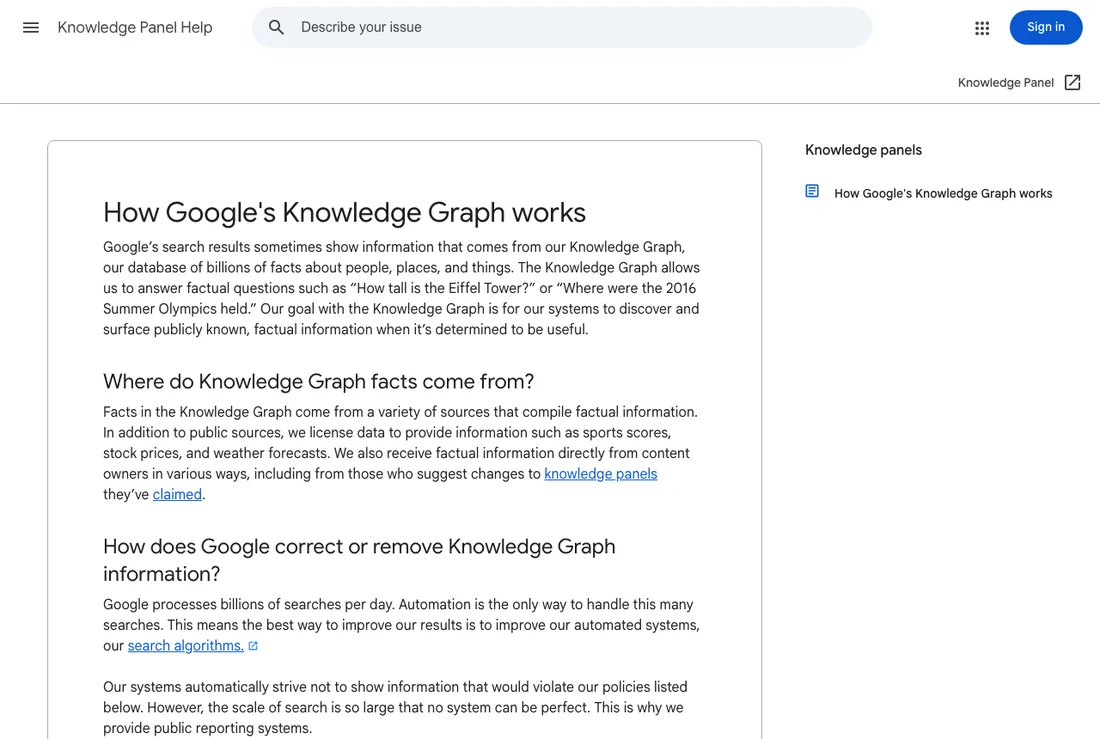
Google's own documentation on claiming a knowledge panel and suggesting edits. Verification is the mechanism for correcting an entity summary, and it applies only where a panel already exists. Screenshot taken 19 August 2026.
The images strip
The images row is where two people most often get confused for each other, because visual results are matched loosely. Photographs from social profiles, event listings, news coverage, and directory pages all surface here, and so occasionally does a photograph of a completely different person with a similar name.
It is worth checking separately from the main results, since it is the part of a name search people scan first and read least carefully.
What never shows up, and why that matters
A search result is not a background check, and confusing the two leads people to worry about the wrong thing.
Not in search results: the file a background screening company holds on you, credit information, most sealed or expunged records, tenancy and employment verification data, and anything behind a login. Those systems exist, they are consulted for real decisions, and they are governed separately. The Consumer Financial Protection Bureau's guidance on credit reports and background screening explains how to obtain a copy of a report about you and how to dispute an entry in it, which is a different and often more consequential process than anything involving a search engine.
Breach data is another absence. Credentials exposed in a breach do not appear in search results, and checking the breach-exposure checker Have I Been Pwned is the separate move for that. A clean first page tells you nothing about it either way.
Ranked by how much weight a reader actually gives it
| Result type | Typical position | Weight a reader gives it |
|---|---|---|
| Your own profiles | Top | High, treated as self-reported |
| Personal site or bio | Top or upper middle | High, treated as authoritative |
| Knowledge panel | Beside results | Very high, if present |
| News coverage | Varies | Very high, treated as verified |
| People-search listing | Middle | Low, widely recognised as compiled |
| Directory or association | Middle | Moderate, treated as verification |
| Images | Middle strip | High, scanned first |
| Forum or community thread | Lower, unless linked | Depends entirely on the site |
The pattern worth noticing is that the results people trust most are the ones you either control or cannot influence, and the results you most want gone are frequently the ones readers discount anyway.
Why two strangers see nearly the same page
Personalisation shapes what you see about yourself far more than what a stranger sees about you, because a stranger has no history with your name. Two people looking you up from different cities will see broadly the same page, with variation from country and language settings. That is why running the search signed out is the only way to know what is actually out there.
If something in those results contains personal contact details, or falls into one of the categories covered by Google's legal removal request process, there is a defined route for asking that it be removed from Search. For everything else the honest answer is that the page stays and the work is about what surrounds it.
Most people who run this exercise find one or two results genuinely worth acting on and a longer list that reads worse to them than it does to anyone else. Separating those two is the first thing a reputation audit does.
Questions about what shows up when someone googles you
What shows up when someone googles me?
Usually your own social profiles and website first, then people-search listings built from public records, directory entries, an images strip, People Also Ask questions, and news if any exists.
How do I control my search results?
You control the results you own. Keep profiles current and consistent, publish a bio page under your own name, opt out of people-search listings, and use the defined removal routes for personal contact details.
Why do people-search sites rank so high for my name?
They create a page for nearly every adult, format it around the exact phrase people type, and face little competing content for most names. Ranking is about matching the query, not about authority.
Does a background check show the same things as Google?
No. A background screening report draws on databases that are not in search results, and it is governed by consumer reporting rules that give you the right to see and dispute it.
Why do I not have a knowledge panel?
Knowledge panels appear for entities the search engine recognises, which is mostly organisations and public figures. Most private individuals do not have one, and its absence is not a problem to solve.